Barbara von Stechow Gallery
www.galerie-von-stechow.com
Feldbergstraße 28
60322 Frankfurt am Main
Partner gallery: Galerie Voss
Leszek Skurski
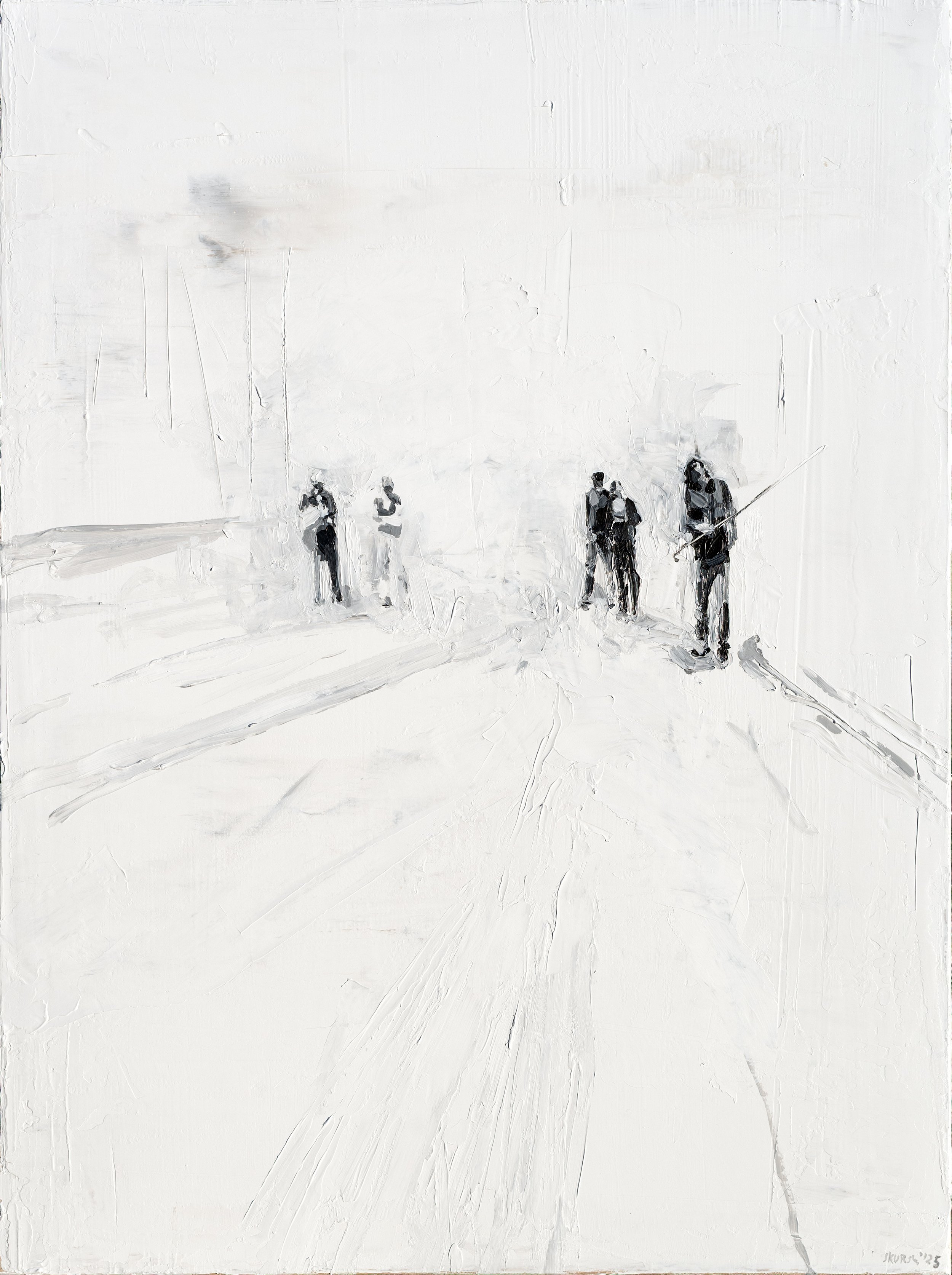
Polish artist Leszek Skurski studied painting at the Academy of Fine Arts in Gdańsk. His largely monochromatic approach is rooted in a figurative narrative style: his works unfold countless stories, large and small, that are deliberately left open. They show moments of limbo, pauses between action and standstill, which Skurski compresses into a condensed visual form and transforms into a characteristic narrative intensity. On canvas, Skurski captures fleeting moments of human existence—alone or in community—that appear like fragments of a sequence, like snapshots hovering between the appearance and disappearance of figures on a stage.
The scenes are reminiscent of cinematic stills, frozen frames that evoke atmosphere, character, and a hidden narrative. They refer to actions that began before the moment depicted and continue beyond it: a single, suspended moment whose intensity is heightened precisely by the silence. In an age characterized by a relentless stream of images and information, Skurski persistently returns to the single image—to the "one" image that can tell an entire story. He often increases the distance to the viewer; by making his subjects appear small and slightly out of focus, he paradoxically brings us closer to the essence of the scene and opens up a more comprehensive understanding of its reality. People remain the center of his work.
After exhibiting throughout Europe, the United States, and South Africa, Skurski began his artistic career with a keen interest in "living beings"—initially in large-format, color-intensive paintings characterized by a diffuse physicality. Today, his figures are reduced to their essentials: small, dark silhouettes in expressive gestures, detached from any tangible surroundings and placed in spaces that are only hinted at, fragmentary, or completely dissolved. These figures move in abstract expanses of subtly modulated, luminous white—a color that, although achromatic, contains the entire color spectrum of light.
In Skurski's paintings, white takes on a multifaceted and open meaning: it can evoke emptiness, silence, or nothingness, but also the intellectual or spiritual—the invisible, the absent, the incomprehensible. This draws our attention more strongly to the invisible, the silence between the gestures. In these light-flooded fields, everything is focused on its human protagonists. Individuals or groups move freely across the picture plane, simultaneously anchored in it and responsible for its spatial tension. They emerge in striking chiaroscuro: at once lonely and connected, isolated and yet related to one another.
In these abstract worlds, his miniature scenes unfold different narrative contexts that shift with the viewer's gaze. We encounter moments of the everyday as well as the extraordinary – "a meeting," "a conversation," "a rendezvous," "a parade," or "an arrival." Elsewhere, his images suggest "help" or "warning." Skurski creates visual worlds that seem quietly familiar and yet subtly unsettling, evoking interpersonal encounters that encourage us to reflect on what we actually see: scenes of conviviality or isolation, relaxation or alienation, observation or surveillance, trust or conspiracy.
They are condensed realities that remain open to interpretation. His images bear witness to the tangible while leaving room for the unseen. The narratives he creates seem to come from another time or place—distant, timeless, placeless. Everything remains unresolved, hovering between presence and absence. What emerges is minimal and at the same time essential: fragments of "information" that unfold in the viewer's imagination like photographic negatives and are only completed by the stories we ourselves project—stories with their own beginnings and endings.