Galerie Voss
www.galerievoss.de
Mühlengasse 3
40213 Düsseldorf
Partner gallery: Galerie Barbara von Stechow
Flávia Junqueira
Flávia Junqueira holds a PhD from the Instituto de Artes da Universidade Estadual de Campinas (UNICAMP), a master's degree in visual poetry from the Universidade de São Paulo (USP), and a bachelor's degree in plastic arts from the Fundação Armando Álvares Penteado. Her works have been exhibited in various museums and institutions around the world, including the Palais de Tokyo (Paris), Instituto Thomie Othake (São Paulo), Museu de Arte Moderna do Rio de Janeiro, Museu de Arte de Brasilia – MAB, and CAC Málaga. Freud asks whether we should look for the first traces of imaginative ability in childhood. In "Creative Writers and Daydreaming," the founder of psychoanalysis brings play into close proximity with the inventiveness of artists and writers.
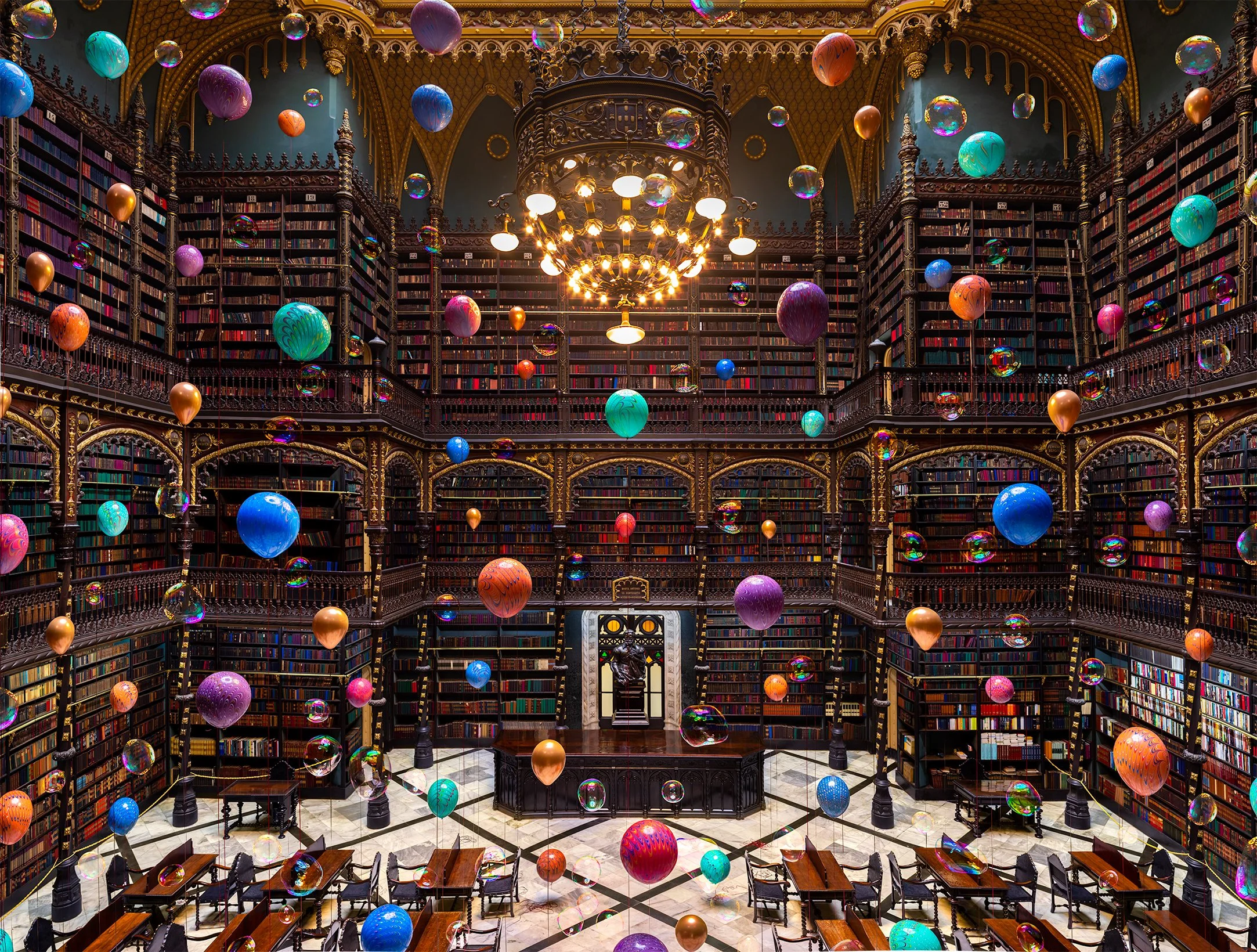
Flávia Junqueira's work possesses this poetic dimension of childlike imagination. In her work, the magical aspect brings into play the possibility of fictionalizing reality, which opens the way to a connection with the initial imagination in the image. The balloons, carousels, toys, and playgrounds portrayed by the artist intensify the radiance of the colors and the subtle impression of the rhythm of the images, which harbor dreams, fantasy, and a call to poetry. In the living matter of memory, streams of pulsating symbols open up. Returning to the roots of childhood is a way of articulating and integrating the different sensory modalities.
The richness of the sensitive world of the child—this kind of "unending origin"—is a source of creation and discovery, as Dutch historian Johan Huizinga emphasizes in his 1938 book Homo Ludens, explaining the importance of play in culture and stating that "civilization arises and develops in and through play.". Charles Baudelaire, too, in his masterful essay on the "morality of toys," found in the child's interaction with toys the first signs of literary or artistic predestination. In the apparent simplicity of children lies a great capacity for improvisation that can grasp what escapes us through inattention.
Real and surreal spaces house invented images that traverse the dimensions of childhood, dreams, and fantasy. Filled with the "memory of things," they create a universe that is flexible, mobile, and expandable. In this respect, their work is close to the artistic ideas that shaped the 20th century—from Van Gogh to Renoir, from Cy Twombly's doodles to photographs of museum paintings with children that show the dimension of distance. From a wandering gaze that does not allow itself to be captured by the obvious, the theme of childhood appears not as a fixed state, but as a changing body that leads to a constant questioning of the visible and the invisible.
And this is the zone where art and childhood converge, which the artist illuminates by tapping into regions where the senses are still permeable and immature. In his book Childhood and History, Giorgio Agamben considers childhood not only as a chronologically or physiologically defined and finite age, but as a form of sensitivity that permeates existence. Flávia Junqueira's work also encompasses this dimension of humor and flirtation with the indomitable and the beauty that hovers between the images.
The balloon—the possibility of vertigo and dreams—and the toy magically transform and establish the game of presence and absence, placing childhood at the center of their work by touching on the inexpressible and the experience of mystery. Psychoanalysis has denaturalized discourses on language and childhood, and with the help of art, we can perceive "how a society dreams of its childhood."
Flávia Junqueira's work focuses on this point because, ultimately, it is always about childhood: what remains of the childhood experience as an imprint on the subject, that is, what remains as a matrix for the rest of life. As in Louise Gluck's infinite poetry, "we look at the world once, as children. The rest is memory." Art never lets the mystery of early days disappear, and Flávia Junqueira updates the subversive idea of play as a gift and a blessing.